Super Imploder Results
The Fractal Water Super Imploder has been rigorously evaluated through independent laboratory testing, university research, and controlled field trials conducted across multiple countries. These studies consistently demonstrate measurable, statistically significant improvements in plant growth rates, seed germination success, water quality parameters, and overall crop yield. Below is a summary of the most important findings from peer-reviewed and independently verified research.
Key Results at a Glance
Macadamia Propagation Study (Boogaers, 2019)
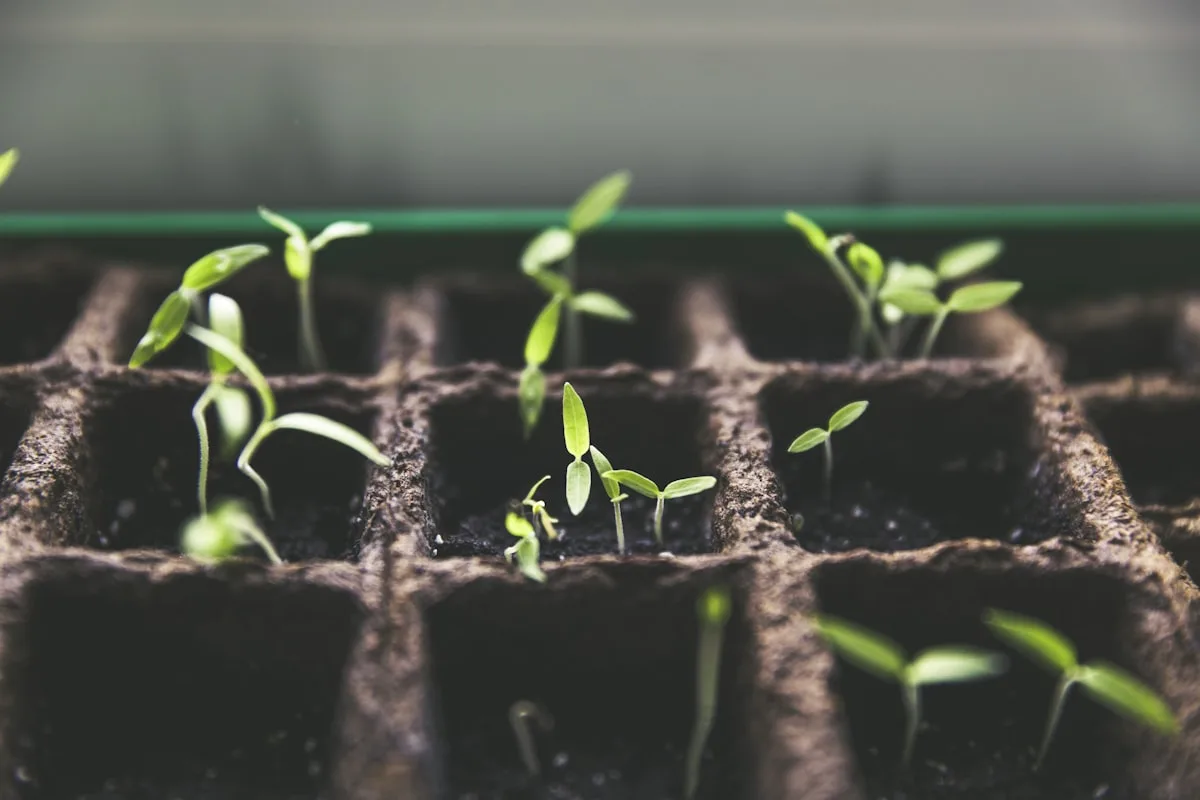
This comprehensive MSc Botany dissertation was completed at North-West University in South Africa. The study evaluated the effects of Fractal Water Imploder-treated irrigation on macadamia nut propagation over a two-year period (2016-2018) across two separate nursery sites. All key metrics reached statistical significance at P<0.001, providing robust evidence for the technology’s effectiveness in commercial agriculture.
Germination & Growth
Soil & Water Effects
Beyond the direct plant physiological benefits, the study documented important secondary effects on soil quality. Magnetized water treatment led to improved soil water retention, enabling more efficient irrigation use. Nutrient levels in the soil increased measurably, while nutrient leaching was reduced, suggesting that treated water helps the growing medium retain essential minerals more effectively.
Download the full Boogaers dissertation (PDF) | Read the full study summary
Plant Growth Trials

Plant Weight Comparison
In an early controlled growth trial, plants irrigated with magnetically treated water reached a final weight of 12.864 grams compared to 3.925 grams for the tap water control group. This represents a 3.28:1 yield ratio, or an increase of up to 228% (results may vary depending on species, soil conditions, and growing environment). The trial was conducted under identical conditions with the only variable being the water treatment method.

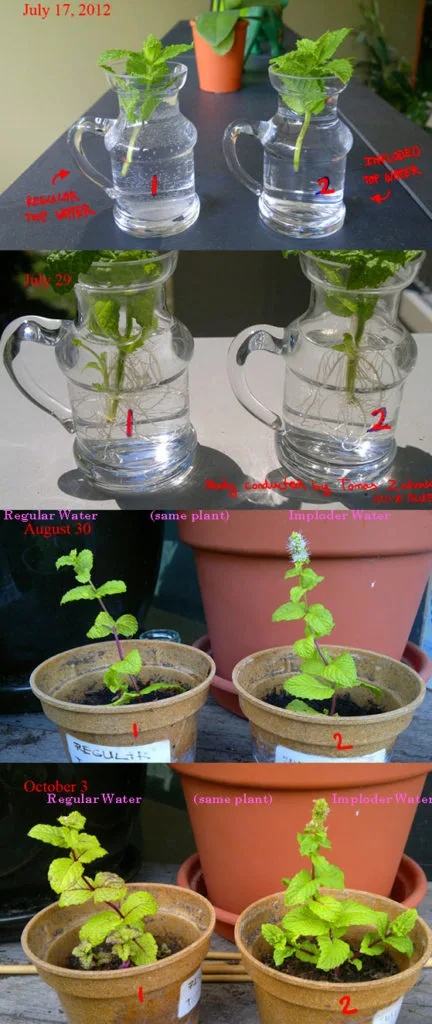
Across multiple independent trials, researchers consistently observed several growth advantages in plants receiving Imploder-treated water: more efficient root branching patterns, more consistent and uniform leaf spacing, earlier onset of flowering, and greater resilience during drought conditions. These observations align with the quantitative data from the Boogaers dissertation and other controlled studies.
Water Quality Testing
Chlorine Reduction

Independent laboratory analysis confirmed a dramatic reduction in chlorine levels when municipal water was passed through the Super Imploder system. The visual comparison shown here illustrates the difference between untreated tap water and Imploder-processed water using a standard chlorine indicator reagent. Many users also report a near-complete elimination of the characteristic chlorine odor in their shower water after installing the system, consistent with the laboratory measurements.
Redox Potential
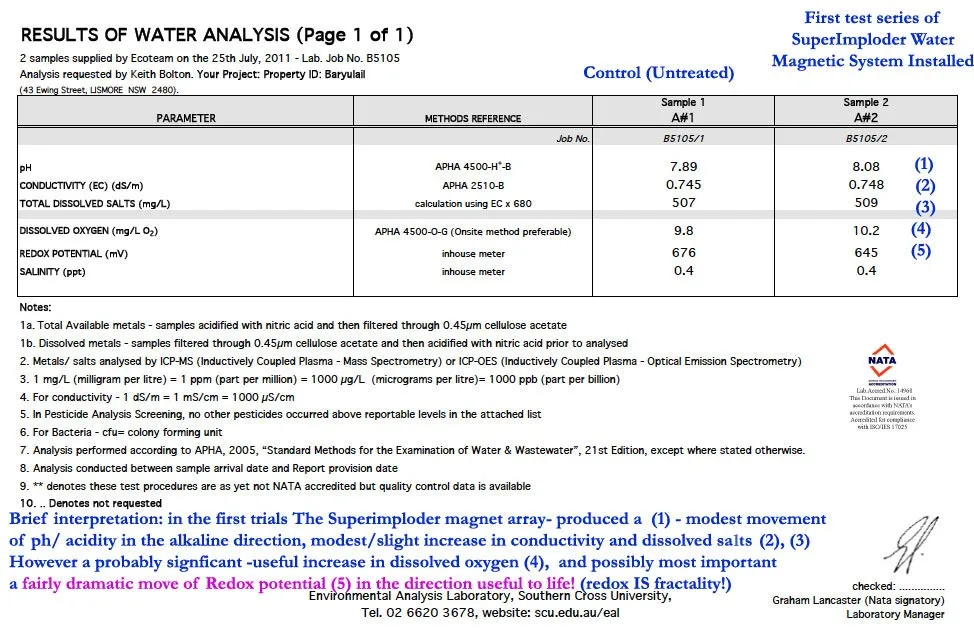
Oxidation-reduction potential (ORP) testing demonstrated a 6.5% decrease after just eight minutes of circulation through the Imploder system. The control sample measured 738.5 mV while the treated sample dropped to 690.2 mV. Lower redox potential in drinking water is generally associated with improved antioxidant properties, making this a meaningful indicator for water intended for human consumption.
Entropy Reduction
Gas Discharge Visualization (GDV) analysis revealed a 46% reduction in water entropy when comparing standard tap water to magnetically treated water. Lower entropy values indicate a more ordered molecular structure, which researchers associate with improved biological availability and enhanced capacity to support living systems.
Independent Validation
The results presented on this page have been corroborated by multiple independent researchers, accredited universities, and agricultural field trials conducted in diverse climates and geographies worldwide. This body of evidence spans controlled laboratory experiments, multi-year nursery studies, and real-world crop production scenarios. For a comprehensive bibliography covering 56 published studies on magnetic water treatment, visit our full research bibliography. For research focused specifically on germination outcomes, see the seed germination research page.